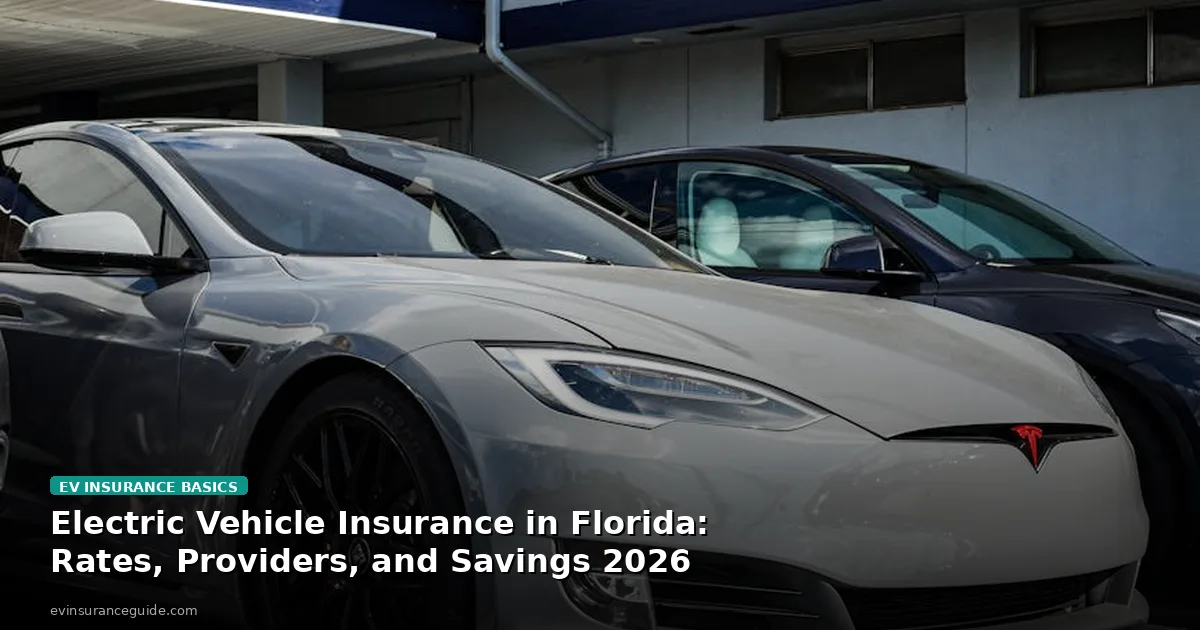
Florida is the third-largest EV market in the US and one of the most expensive states for auto insurance overall. EV owners in Florida pay an average of $3,000 to $5,600 per year for full coverage — roughly 20-25% more than gas vehicle owners due to higher replacement costs and Florida's unique insurance landscape.
Florida EV Insurance Rates by Provider
| Provider | Tesla Model 3 Annual | Ioniq 5 Annual | FL Specialty |
|---|---|---|---|
| USAA | $2,600 | $2,000 | Military only |
| State Farm | $3,000 | $2,300 | Largest in FL |
| GEICO | $3,200 | $2,400 | Strong discounts |
| Progressive | $3,100 | $2,400 | Snapshot telematics |
| Tesla Insurance | $2,200-$4,200 | N/A | Safety Score-based |
| Allstate | $3,600 | $2,800 | Drivewise savings |
| Citizens | $4,200 | $3,400 | Insurer of last resort |
| Farmers | $3,800 | $3,000 | Bundling discounts |
State Farm dominates the Florida market and generally offers the most competitive EV rates outside of USAA. Their agent network in Florida is extensive, and they handle EV claims through a dedicated team.
Tesla Insurance launched in Florida and uses real-time Safety Score data. Safe Florida Tesla drivers with 90+ scores routinely get rates 30-40% below traditional carriers. This makes Tesla Insurance one of the best options for careful Tesla owners in the state.
Why Florida EV Insurance Is Expensive
No-fault state — Florida is a no-fault state requiring $10,000 in Personal Injury Protection (PIP). Every driver pays for PIP regardless of driving record, adding $300-$800/year to every policy.
Property damage liability minimum is only $10,000 — Florida has the lowest PD liability minimum in the country. A minor EV collision can easily exceed $10,000 in damages. Drivers carrying only minimums are effectively underinsured from the first dollar.
No bodily injury liability required (with caveats) — Florida doesn't mandate BI liability unless you've had your license suspended. However, any EV owner should carry at least 100/300 BI liability — being sued personally for injury costs in a state with no mandatory BI is a devastating financial risk.
Hurricane and flood exposure — Florida's hurricane season creates significant comprehensive insurance claims. EVs are particularly vulnerable to flood damage because saltwater contact with the battery pack can cause total-loss claims. Comprehensive premiums in coastal Florida ZIP codes run 40-70% higher than inland areas.
Uninsured drivers — Florida has the highest uninsured motorist rate in the US at approximately 20%. One in five drivers on Florida roads has no insurance, making Uninsured Motorist coverage essential despite not being legally mandatory.
Fraud and litigation — Florida's auto insurance fraud rate is among the highest nationally, which inflates premiums for all drivers.
Florida EV Insurance by Region
| Region | Avg Annual EV Premium | Key Factor |
|---|---|---|
| Miami-Dade | $4,400-$5,600 | Fraud, theft, density |
| Broward County | $4,000-$5,200 | South FL rates |
| Palm Beach | $3,600-$4,800 | Moderate urban |
| Orlando | $3,200-$4,200 | Tourist traffic |
| Tampa Bay | $3,000-$4,000 | Growing EV market |
| Jacksonville | $2,800-$3,800 | Lower density |
| Sarasota/Naples | $2,600-$3,600 | Retirement community |
| Gainesville/Tallahassee | $2,400-$3,200 | College towns, lower risk |
South Florida (Miami, Fort Lauderdale, West Palm Beach) consistently has the highest auto insurance rates in the state and some of the highest in the country.
Florida EV Owner Tip: Flood damage is the #1 comprehensive claim for Florida EVs. If you're in a flood zone, strongly consider comprehensive coverage with a low deductible. A single saltwater flood event that reaches the battery pack will total most EVs — that's a $30,000-$60,000 loss without comprehensive coverage.
Florida-Specific EV Insurance Savings
Hurricane deductible awareness — Many Florida comprehensive policies have separate hurricane deductibles (typically 2-5% of the vehicle's insured value) that are higher than the standard deductible. Understand your hurricane deductible before storm season. On a $50,000 Tesla Model Y, a 5% hurricane deductible means $2,500 out of pocket.
Dashcam discount — Several Florida insurers (including State Farm and Progressive) offer dashcam discounts of 3-5%. Florida's high fraud rate makes documented evidence valuable to insurers.
Wind mitigation — If you park your EV in a garage rated for wind resistance, some insurers reduce comprehensive premiums. This is more common for homeowners insurance but occasionally applies to auto comprehensive in hurricane-prone areas.
Defensive driving course — Florida's 4-hour Basic Driver Improvement course earns insurance discounts of up to 10% for 3 years. Drivers 55+ can take the AARP Smart Driver course for additional savings.
Pay-per-mile options — EV owners who work from home or have short commutes benefit from usage-based programs. Florida retirees with EVs driven under 5,000 miles/year can save 20-35% through mileage-based pricing.
EV Insurance for Florida Snowbirds
Part-time Florida residents (snowbirds) face unique EV insurance situations:
Dual-state registration — If your EV is registered in Florida and you spend winters there, Florida insurance rates apply. Some snowbirds register vehicles in their northern state where rates may be lower, but the vehicle must be primarily garaged at the registered address.
Seasonal coverage adjustments — Some insurers allow reducing coverage during months the vehicle is stored. If your EV sits in a Florida garage for 6 months while you're north, you can potentially drop collision coverage during storage (keeping comprehensive for theft/weather) and save 15-25%.
Multi-state coverage — Your Florida EV policy covers you in all 50 states. However, if you're regularly driving between Florida and another state, verify your policy's garaging address matches where the vehicle spends the majority of its time.
FAQs About Florida EV Insurance
Does Florida require full coverage for EVs?
No. Florida only requires $10,000 PIP and $10,000 PD liability. However, these minimums are grossly inadequate for EV owners. Full coverage with 100/300/100 liability, $50,000 PIP, uninsured motorist, collision, and comprehensive is strongly recommended.
Is Tesla Insurance available in Florida?
Yes. Tesla Insurance operates in Florida and is often the cheapest option for Tesla owners with high Safety Scores. Florida was one of Tesla Insurance's early markets.
How does hurricane damage affect my EV insurance?
Hurricane damage (wind, flood, storm surge) is covered under comprehensive. However, your hurricane deductible may be higher than your regular deductible — typically 2-5% of the vehicle's value. A flood that reaches the battery pack will almost certainly total the EV.
Are there Florida state EV insurance incentives?
Florida doesn't offer state-specific EV insurance discounts or incentives. However, the state has no personal income tax, which partially offsets higher insurance costs. Some FL counties offer reduced registration fees for EVs.
Can I insure a golf cart EV in Florida?
Low-speed electric vehicles (LSVs) and golf carts require separate coverage in Florida. Traditional auto insurance doesn't cover LSVs. Specialty insurers like Foremost and Hagerty offer LSV policies for $200-$600/year in Florida's golf cart communities.
Florida's EV insurance market is expensive but competitive. The gap between the cheapest and most expensive provider can be $2,000+/year, making comparison shopping the single most effective way to reduce your premium. Get quotes from at least 5 carriers, take the defensive driving course, and make sure your comprehensive coverage is adequate for hurricane season.