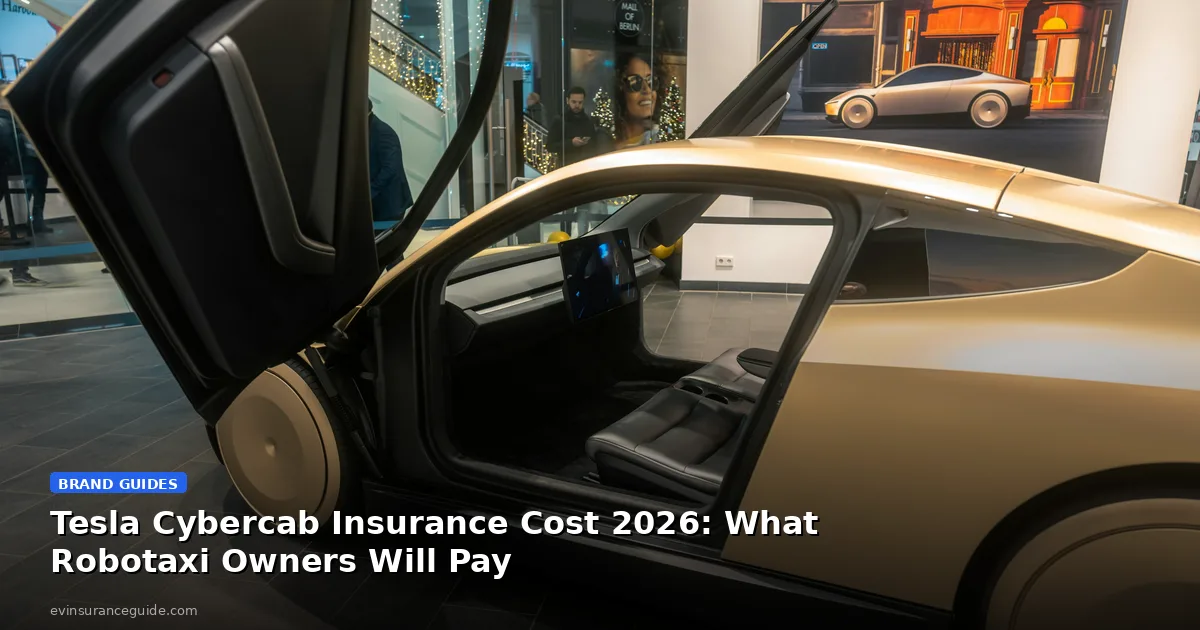
The Tesla Cybercab Is Here — But Can You Insure It?
Tesla's Cybercab rolled off the Gigafactory Texas production line in early 2026, and it's unlike anything the insurance industry has ever had to price. No steering wheel. No pedals. A fully autonomous two-seater designed to operate without human intervention. The sticker price sits around $30,000 — but the real question everyone's asking is: what will insurance actually cost?
The short answer: nobody knows for certain yet. But we can make some educated projections based on what we know about Tesla Insurance, autonomous vehicle regulations, and the current EV insurance market.
Projected Insurance Costs for the Cybercab
Traditional auto insurance pricing is built on driver behavior — your age, driving record, credit score, annual mileage. The Cybercab throws most of that out the window. There's no driver. The car is the driver.
Here's how costs might shake out based on current data:
| Scenario | Estimated Annual Premium | Notes |
|---|---|---|
| Tesla Insurance bundle (personal owner) | $1,200 – $1,800 | Bundled at purchase, likely the cheapest option |
| Third-party insurer (if available) | $2,000 – $3,500 | Limited data means higher risk pricing |
| Fleet/commercial policy | $800 – $1,400 per vehicle | Volume discounts for multi-vehicle fleets |
| Musk's $0.20/mile target (insurance portion) | ~$600 – $900/year | Based on 15,000 miles annually |
For context, the average Tesla Model 3 costs about $364/month to insure — roughly $4,368 per year. The Cybercab should theoretically cost less because there's no human error factor, which accounts for roughly 94% of all crashes according to NHTSA data.
Why Tesla Insurance Is the Most Likely Provider
Here's the reality: most traditional insurers — GEICO, Progressive, State Farm — don't have the actuarial data to price a fully autonomous vehicle. They've never had to. Their entire model is built on evaluating human risk.
Tesla Insurance, on the other hand, has direct access to the vehicle's Full Self-Driving telemetry. They know exactly how the car performs in every scenario. That data advantage is massive.
Currently, Tesla Insurance operates in 12 US states and has scaled to over $500 million in annual premiums. The most logical move is for Tesla to bundle Cybercab insurance directly into the purchase or lease agreement — similar to how smartphone protection plans work.
States Where Tesla Insurance Is Available (2026)
- Arizona, California, Colorado, Illinois, Maryland, Minnesota, Nevada, Ohio, Oregon, Texas, Utah, Virginia
If you live outside these states, insuring a Cybercab could be significantly more complicated and expensive in the early days.
The Factors That Will Determine Your Premium
Even without a human driver, insurers will still evaluate risk. Here are the key factors:
1. Software Version and Safety Record The Cybercab's FSD software version will likely become the single biggest factor in premium calculation. Think of it like a driver's record, but for algorithms. If Tesla's FSD v13.x has a proven safety record of fewer incidents per million miles than human drivers, premiums should drop accordingly.
2. Geographic Operating Area A Cybercab operating in downtown San Francisco will cost more to insure than one in suburban Phoenix. Dense urban environments mean more pedestrians, cyclists, and unpredictable situations. State regulations also vary wildly — some states haven't even created frameworks for autonomous vehicle registration yet.
3. Usage Pattern Are you using your Cybercab as a personal vehicle, or deploying it as a revenue-generating robotaxi? Commercial use always costs more to insure, but Tesla's fleet pricing could offset this. Musk has stated the goal is $0.20 per mile all-in, which includes insurance, charging, maintenance, and depreciation.
4. Repair Costs The Cybercab uses a simplified design — fewer moving parts, no steering column, no pedals — which could reduce repair costs. However, the autonomous sensor array (cameras, radar, computing hardware) is expensive to replace. Early estimates suggest a fender-bender could still cost $3,000 – $8,000 to repair due to sensor recalibration alone.
How Cybercab Insurance Compares to Other Teslas
| Model | Avg. Monthly Premium | Annual Cost |
|---|---|---|
| Tesla Model 3 | $364/mo | $4,368 |
| Tesla Model S | $389/mo | $4,668 |
| Tesla Model Y | ~$340/mo | $4,080 |
| Tesla Cybertruck | ~$400/mo | $4,800 |
| Tesla Cybercab (projected) | $100 – $150/mo | $1,200 – $1,800 |
The Cybercab's projected lower premiums make sense: no driver means no DUIs, no distracted driving, no road rage. The vehicle's entire risk profile is determined by software reliability rather than human unpredictability.
What You Need to Know Before Buying
If you're planning to buy a Cybercab in 2026 or early 2027, here's what to keep in mind:
Check your state's autonomous vehicle laws. Not every state allows fully autonomous vehicles without a licensed driver present. Some states may require a special permit or registration class.
Budget for Tesla Insurance. In the early days, Tesla's own insurance will almost certainly be the only practical option. Factor the bundled premium into your total cost of ownership.
Understand the liability gap. This is the big one. If your Cybercab is involved in an accident, who's liable — you or Tesla? The legal framework is still evolving. We dive deeper into this in our Cybercab liability guide.
Don't expect traditional quotes. If you call Progressive or GEICO asking to insure a Cybercab, expect confusion. These companies are still building out their autonomous vehicle pricing models.
The Bottom Line
The Tesla Cybercab represents a fundamental shift in how we think about car insurance. For the first time, the driver is software — and that changes everything about risk assessment, liability, and pricing.
Our projection: early Cybercab owners will pay between $1,200 and $1,800 per year through Tesla Insurance, with commercial fleet operators paying even less per vehicle. As the FSD safety record grows and more insurers enter the market, expect premiums to drop further.
The $30,000 Cybercab with $1,500/year insurance could end up being one of the cheapest vehicles to own in 2027 — especially if you're earning revenue from it as a robotaxi. That's a story we'll be watching closely.
Interested in fleet ownership? Read our Cybercab Fleet Insurance Guide for commercial coverage options.