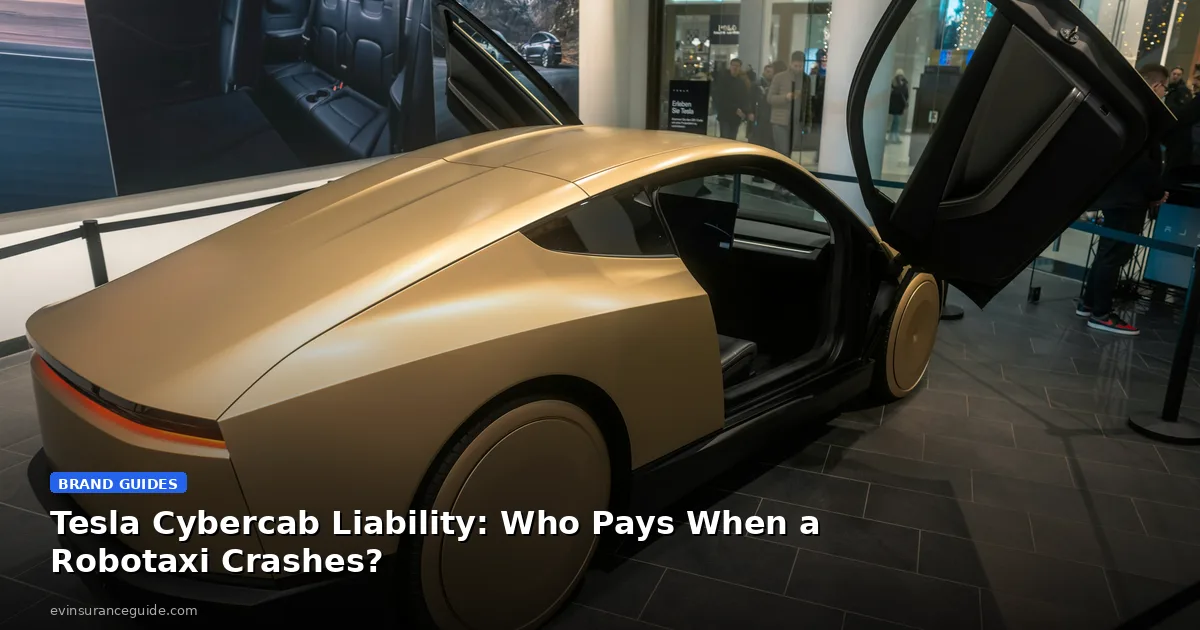
A Car With No Driver Crashes. Who's Responsible?
The Tesla Cybercab doesn't have a steering wheel. It doesn't have pedals. There's no human behind the wheel making split-second decisions. So when something goes wrong — and statistically, it will eventually — the question isn't if someone pays, but who.
This is the single biggest unresolved question in the autonomous vehicle industry, and it directly affects every person considering buying, leasing, or operating a Cybercab in 2026 and beyond.
The Current Legal Landscape
As of March 2026, there is no federal legislation in the United States that specifically addresses liability for fully autonomous vehicles. That means the rules vary dramatically by state:
States With Autonomous Vehicle Frameworks - California: Requires a permit for autonomous vehicle testing and deployment. Manufacturers must carry $5 million in liability coverage. - Arizona: One of the most permissive states. Allows fully driverless vehicles with minimal restrictions. - Texas: Permits autonomous vehicles but places liability on the vehicle's operator — which could mean the owner, even if they're not in the car. - Nevada: Requires manufacturers to provide proof of insurance or self-insurance for autonomous vehicles.
States With No Framework Many states haven't addressed autonomous vehicles at all. In these jurisdictions, standard auto liability laws apply — which means the registered owner is likely on the hook.
Three Possible Liability Models
The insurance and legal communities are converging on three potential frameworks for Cybercab liability:
Model 1: Owner Liability (Current Default)
Under existing auto insurance law in most states, the registered owner of a vehicle bears liability. This means if your Cybercab runs a red light and hits a pedestrian, you are responsible — even though you had zero control over the vehicle's actions.
Pros: Simple, fits existing legal frameworks Cons: Fundamentally unfair to owners who have no ability to prevent accidents
This is the model that applies by default in states without autonomous-specific legislation, and it's the reason insuring a Cybercab could be complicated.
Model 2: Manufacturer Liability (Product Liability)
Under this model, Tesla would bear responsibility for any accidents caused by FSD software errors. This follows the same logic as product liability law — if a defective product causes harm, the manufacturer pays.
Pros: Makes logical sense — Tesla controls the software, Tesla should bear the risk Cons: Tesla has historically fought aggressively against accepting FSD liability in court
Volvo notably pledged to accept full liability for crashes in its autonomous vehicles. Tesla has made no such commitment. In fact, recent legal proceedings suggest Tesla will vigorously defend against liability claims and attempt to shift responsibility to vehicle owners.
Model 3: Shared Liability (Hybrid)
The most likely outcome is a hybrid model where liability is split: - Tesla is liable for software failures (FSD bugs, sensor malfunctions, mapping errors) - The owner is liable for maintenance failures (worn tires, dirty sensors, improper modifications) - Insurance covers the gap through specialized autonomous vehicle policies
This is similar to how commercial aviation works — the aircraft manufacturer, airline, and maintenance provider all share varying degrees of liability depending on the cause of an incident.
What Tesla Has Said (and What They Haven't)
Tesla has confirmed that its insurance platform will provide coverage for Cybercab owners. Elon Musk has stated the target operating cost is $0.20 per mile, which includes an insurance component.
However, Tesla has not committed to: - Accepting liability for FSD-caused accidents - Covering claims that exceed standard policy limits - Providing insurance in all 50 states at launch
This gap between what Tesla implies and what Tesla guarantees is something every potential Cybercab buyer needs to understand clearly.
Real-World Scenarios: Who Pays?
Let's walk through some hypothetical situations:
Scenario 1: Cybercab Runs a Red Light The FSD system misreads a traffic signal and enters an intersection, causing a collision. In this case, the software made the error. Under a manufacturer liability model, Tesla would pay. Under owner liability, you pay through your insurance. The likely outcome: your insurance pays the claim, then your insurer sues Tesla for the software defect.
Scenario 2: Cybercab Hits a Pedestrian in a Crosswalk The sensors failed to detect a pedestrian wearing dark clothing at night. This could fall on Tesla (sensor/software failure) or on the owner (if a sensor was dirty or damaged). Expect litigation to determine fault.
Scenario 3: Passenger Injured During Emergency Braking Your Cybercab brakes hard to avoid an obstacle, and the passenger who called the robotaxi is injured. If you're running it as a commercial robotaxi, your commercial policy covers this. If it's personal use, your personal auto policy's medical payments coverage applies.
Scenario 4: Cybercab Is Hacked A cybersecurity breach causes your Cybercab to behave erratically. This is an emerging risk category. Most standard auto policies don't cover cyber incidents. Tesla's policy may or may not cover this — the fine print matters enormously.
How to Protect Yourself as a Cybercab Owner
1. Carry Maximum Liability Coverage Don't skimp on liability limits. Consider at least $500,000 in bodily injury coverage per occurrence. An umbrella policy is strongly recommended for anyone operating a vehicle they don't physically control.
2. Document Everything Keep records of all software updates, maintenance, and sensor cleanings. If Tesla tries to shift liability to you for a maintenance failure, you'll want proof that you kept the vehicle in proper condition.
3. Understand Your State's Laws Check whether your state has autonomous vehicle legislation and how it assigns liability. This will directly determine your exposure.
4. Consider a Commercial Policy If you're using the Cybercab as a robotaxi (even occasionally), a personal auto policy won't cover you. You'll need commercial coverage. See our Cybercab fleet insurance guide for details.
5. Read the Tesla Insurance Policy Carefully If you go with Tesla Insurance, read every clause. Pay special attention to exclusions, liability limits, and what happens when the FSD system is at fault. The difference between coverage and adequate coverage could be hundreds of thousands of dollars.
The Bigger Picture
The Cybercab liability question isn't just about Tesla — it's about the future of transportation. As autonomous vehicles become mainstream, the entire insurance industry will need to rebuild its models around software risk rather than human risk.
Countries like the UK and Germany are already ahead of the US in creating autonomous vehicle liability frameworks. The UK's Automated Vehicles Act places primary liability on the vehicle manufacturer for incidents occurring during autonomous operation. The US may eventually follow suit, but don't count on it happening before your Cybercab is delivered.
For now, the safest approach is to assume you will bear liability and insure accordingly. If the law eventually shifts to manufacturer liability, you'll have overpaid on insurance — but that's far better than the alternative of being underinsured when an autonomous vehicle you own causes serious harm.
What Comes Next
We expect to see significant legislative movement in 2026-2027 as Cybercabs hit public roads. Several states are already drafting autonomous vehicle liability bills. Tesla's approach to insurance bundling will also become clearer as deliveries begin.
We'll continue updating this guide as the legal landscape evolves. For current pricing estimates, check our Cybercab insurance cost breakdown.
Planning to run a Cybercab fleet? Read our Fleet Insurance Owner's Guide for commercial coverage strategies.