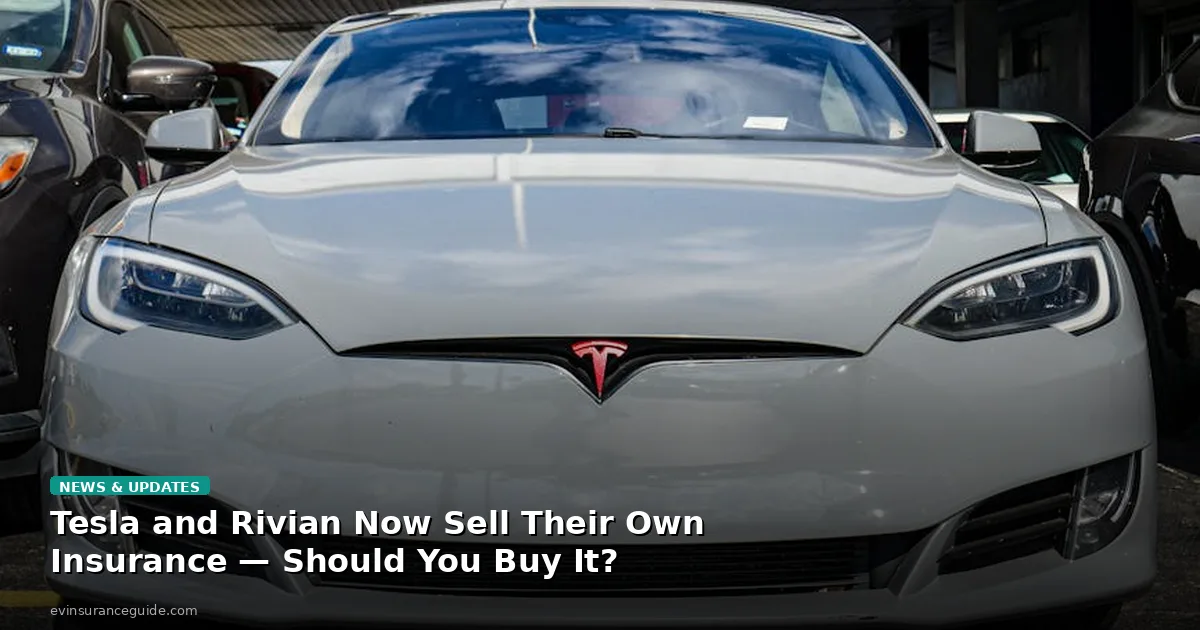
A quiet revolution is reshaping EV insurance: the car manufacturers themselves are becoming insurance providers. Tesla Insurance now operates in 12 states, Rivian Insurance covers 40 states, and GM is building out its own insurance arm. The pitch is simple — who understands the risk of driving an EV better than the company that built it?
But is manufacturer-backed insurance actually a better deal? Here's what EV owners need to know in 2026.
How OEM Insurance Programs Work
Traditional insurance companies assess your risk using credit scores, driving history, ZIP code, age, and vehicle type. They treat your EV as a line item on an actuarial table.
OEM insurers flip that model. Because they built the vehicle and maintain constant data connections to it, they can assess risk with far more granularity:
- Real-time driving behavior — acceleration patterns, braking force, cornering speed, following distance
- Vehicle health data — battery condition, tire wear, brake pad status, software update history
- Actual usage patterns — daily mileage, time of day driven, highway vs. city split
- Safety system engagement — how often Autopilot/driver-assist features are active and whether the driver overrides them
This data advantage theoretically allows OEM insurers to price policies more accurately, rewarding safe drivers with lower premiums and identifying high-risk behavior that traditional insurers would miss.
Tesla Insurance: The Details
Tesla Insurance launched in California in 2019 and has since expanded to 12 states. It uses Tesla's proprietary Safety Score — a 0-to-100 rating calculated from your driving data — to set your premium.
How the Safety Score works:
Your score updates monthly based on five factors: forward collision warnings per 1,000 miles, hard braking events, aggressive turning, unsafe following distance, and forced Autopilot disengagements. A score of 90+ earns the best rates; below 60 pushes premiums significantly higher.
Pricing: Tesla claims its insurance can save drivers 20–40% compared to traditional carriers, and for high Safety Score drivers, that claim holds up. However, drivers with scores below 70 often find Tesla Insurance is actually more expensive than competitors like GEICO or Progressive.
Key advantages: - No traditional credit score check - Monthly billing with no long-term commitment - Seamless integration with the Tesla app - Claims process tied directly to Tesla's repair network
Key drawbacks: - Available in only 12 states (as of March 2026) - Your driving is constantly monitored and scored - Premium can swing significantly month-to-month based on your Safety Score - Limited bundling options (can't bundle with home insurance)
Rivian Insurance: The Details
Rivian Insurance launched more broadly, now available in 40 states for R1T and R1S owners. Like Tesla, it leverages vehicle connectivity data, but its approach differs in important ways.
How Rivian prices policies:
Rather than a single numerical score, Rivian uses a multi-factor model that combines driving behavior with vehicle-specific risk data. Rivian Insurance also offers an opt-in discount for drivers who regularly use Rivian's driver-assistance features, arguing that these systems demonstrably reduce accident rates.
Pricing: Rivian owners face some of the highest EV insurance premiums in the market — the R1S averages $477/month for full coverage through traditional insurers. Rivian Insurance claims to undercut traditional carriers by 15–25% for its vehicles, primarily because it has more accurate repair cost data and direct relationships with its repair network.
Key advantages: - Available in 40 states — far broader than Tesla - Discount for using driver-assistance features - Direct access to Rivian's certified repair network for claims - Coverage specifically designed around R1T and R1S risk profiles
Key drawbacks: - Only available for Rivian vehicles - Still relatively new with limited long-term track record - Premiums remain high in absolute terms (even discounted R1S coverage exceeds $350/month) - Less transparent about exactly how driving data affects pricing
GM's Insurance Play
General Motors is the latest automaker entering insurance through its OnStar Insurance arm. While still in early stages, GM has a massive advantage: scale. With millions of connected vehicles on the road across Chevrolet, GMC, Buick, and Cadillac brands, GM's data pool dwarfs Tesla's and Rivian's combined.
GM's approach focuses on the Chevrolet Equinox EV, Blazer EV, and Cadillac Lyriq — vehicles that are already among the most affordable EVs to insure. If OnStar Insurance can further reduce premiums by 10–15%, it could make these models genuinely cheaper to insure than many gas cars.
Should You Buy OEM Insurance?
The answer depends on your specific situation:
OEM insurance makes sense if: - You're a consistently safe driver who will score well on behavior-based metrics - You drive a Tesla or Rivian and face high premiums from traditional carriers - You value the convenience of a fully integrated app experience - You want claims handled through the manufacturer's certified repair network
Stick with traditional insurance if: - You want to bundle auto + home for maximum savings - You're uncomfortable with constant driving behavior monitoring - You need coverage in a state where OEM insurance isn't available - You want long-term rate stability (OEM rates can fluctuate monthly) - You drive an EV from a brand that doesn't offer its own insurance
The Bigger Picture
OEM insurance programs are still a small slice of the market, but their impact is outsized. By forcing traditional insurers to compete on EV-specific pricing and repair knowledge, they're helping drive premiums down across the entire EV insurance sector.
The long-term trajectory is clear: as more manufacturers launch insurance products and collect driving data, the old model of pricing EV insurance based on generic risk tables will become obsolete. That's good news for every EV owner, whether you buy manufacturer insurance or not.
For now, the best strategy remains the same: compare quotes from multiple sources — including OEM options if available — and choose the policy that best balances price, coverage, and convenience for your situation.