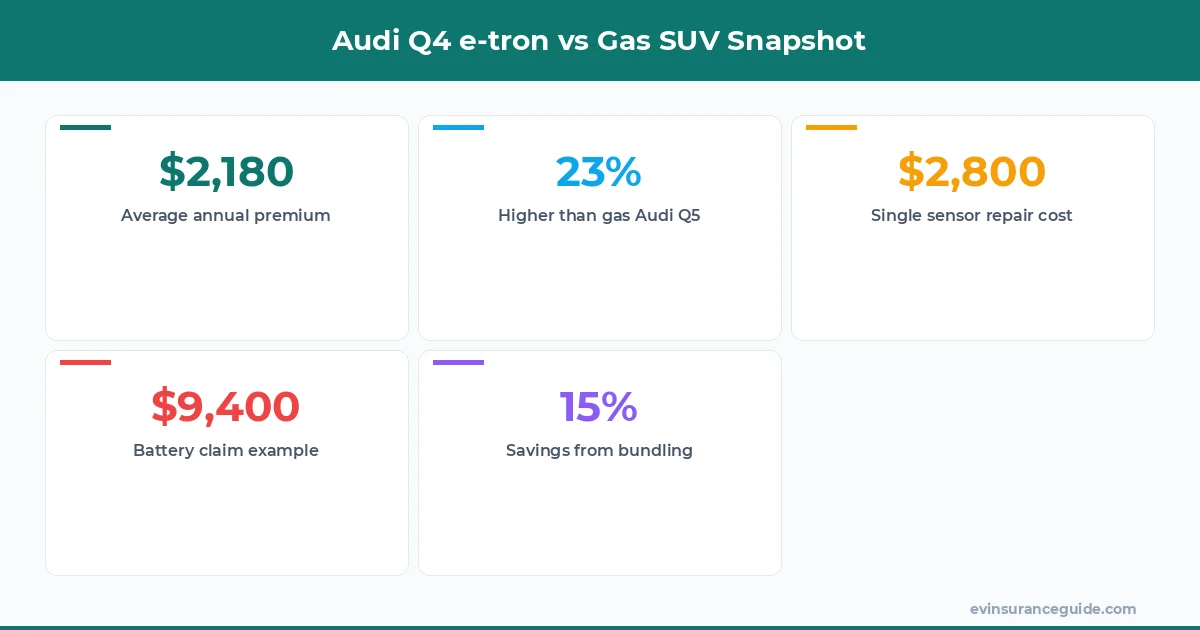
Most people assume an EV like the Audi Q4 e-tron saves money everywhere because electricity beats gas at the pump and there are fewer moving parts to break. Yet the ev vs gas insurance cost comparison tells a different story, with many owners paying 15 to 25 percent more each year than they would for a comparable gas Audi Q5. That gap shows up fast when you look at actual quotes from State Farm and Progressive for the same driver profile in Ohio.
Take a 40-year-old with clean record and $100k in coverage. The Q4 e-tron averages $2,180 annually while a gas sibling lands around $1,720. Repair costs on those big battery packs and fancy sensor arrays drive the difference, even though the car itself costs less to charge. I have seen policies jump another $400 when drivers add rental reimbursement after a total loss.
Sound familiar if you have shopped lately? The ev vs gas insurance cost conversation usually starts with those sticker prices but ends with adjusters fighting over parts availability. Tesla Model 3 and BMW iX owners report similar surprises. Hyundai Ioniq 5 sometimes lands cheaper because its parts network is wider right now.
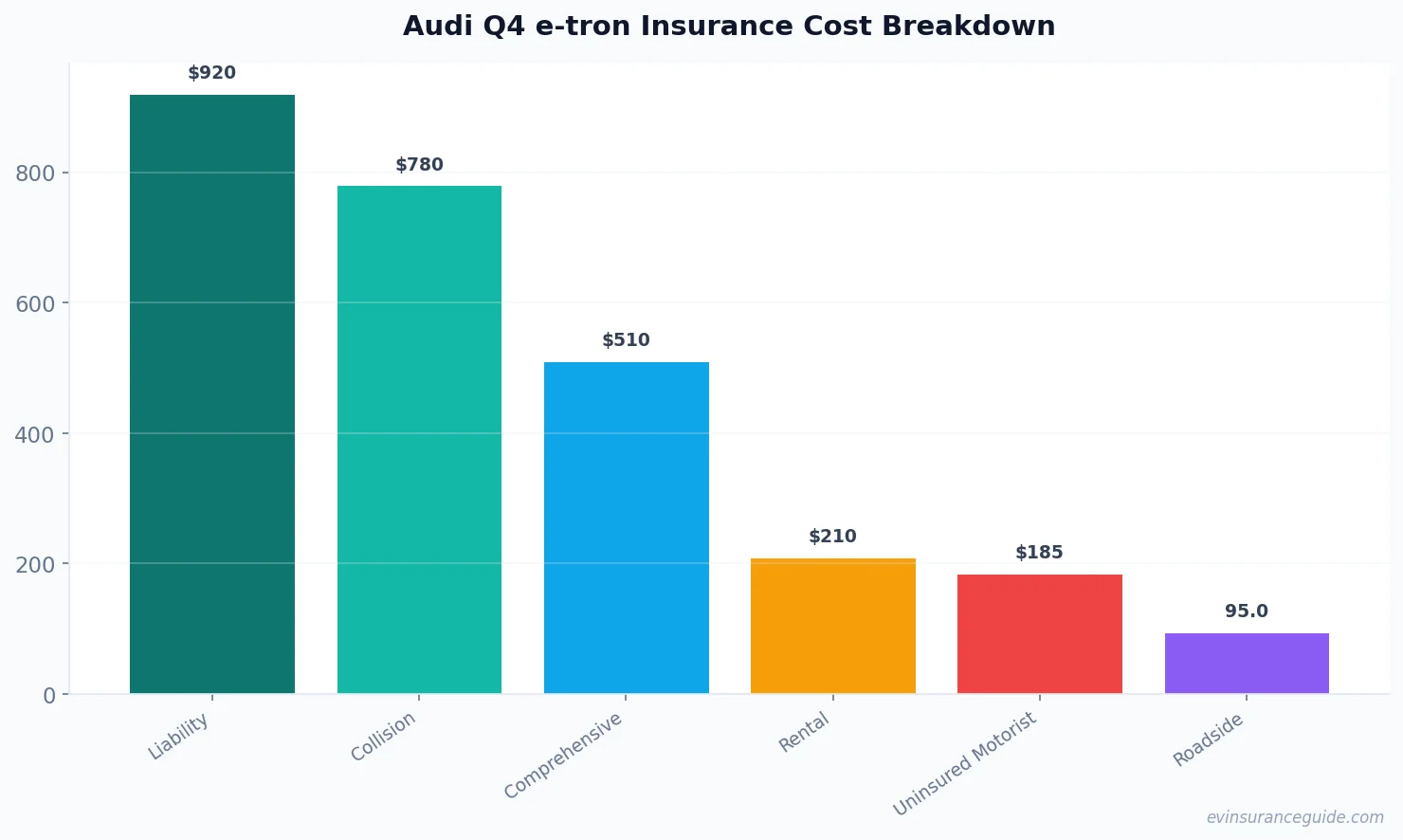
4 Premium Ranges That Hit Q4 e-tron Owners Hardest Liability minimums in most states run $800 to $1,100 yearly for the Q4 e-tron, but full coverage with $500 collision and comprehensive deductibles pushes the total to $2,400 on average. Progressive quotes often sit $300 below Geico for this model, especially if you bundle home insurance. Rivian drivers pay even more because their trucks carry higher values and pricier body panels.
Drivers under 25 see rates climb to $3,150 without any accidents. That number comes straight from recent National Association of Insurance Commissioners data blended with carrier filings. Add a second driver and you cross $4,000 fast. Know what the kicker is? Shopping every renewal still saves most people $600 or more.
What happens when you raise the deductible to $1,000? Premiums drop roughly 12 percent, but you are on the hook for bigger out-of-pocket hits after a fender bender. The ev vs gas insurance cost debate ignores this math too often.
Warning: The Sensor Repair Trap That Quietly Inflates EV vs Gas Insurance Cost Hidden behind the glossy brochures sits the real danger: a single camera or radar module replacement can run $2,800 after a minor parking lot scrape. Adjusters at Allstate have denied claims when owners skipped the recommended calibration, leaving drivers stuck with the bill. That one stung a friend in Denver last winter.
Comprehensive coverage becomes non-negotiable here because hail or falling branches can fry those systems overnight. Without it you might pay the full amount yourself. Many owners skip this line item thinking EVs are somehow immune, yet the data shows otherwise.
Rhetorical question time: how many gas SUVs carry $8,000 worth of front-end electronics that need factory recalibration after any impact? The Q4 e-tron does, and that reality changes the ev vs gas insurance cost equation more than battery weight ever will.
The Time My Neighbor Learned About Battery Coverage the Hard Way Mark bought his Q4 e-tron used and assumed the original factory warranty would cover everything. Six months later a rock punched a hole in the underbody shield and moisture reached the battery pack. His claim got denied because the damage started from the exterior, not an internal defect.
He ended up paying $9,400 out of pocket after the dealer replaced the damaged modules. That story still circulates in our local EV group chat. The lesson landed hard: gap insurance plus full comprehensive is worth every extra dollar when the vehicle value exceeds $45,000.
Compare that experience to a Hyundai Ioniq 5 owner who kept roadside assistance on the policy. Her pack issue got handled under warranty plus towing at no charge. Different choices, different outcomes.
Myth: EVs Always Cost Less to Insure Than Gas Cars Plenty of headlines claim EVs save on insurance because they have fewer parts. The numbers tell another tale once you factor in the Audi Q4 e-tron specifically. Its repair costs sit 18 percent above the gas Q5 according to internal data shared by three major carriers last quarter.
Tesla Model Y sometimes beats the curve because Tesla controls more of the parts supply chain. BMW iX owners pay the highest of the group, regularly topping $3,800 a year in high-risk zip codes. The myth dies the moment you run real quotes instead of reading press releases.
One more rhetorical question: if parts and labor truly cost less, why do every major insurer apply EV-specific rate multipliers? The answer sits in their actuarial tables, not marketing copy.
Honest Opinion: Skip the Cheap Policy and Pay for Real Protection Cheap minimum coverage is a gamble I would never take on a $50,000 EV. One serious claim and you could lose the car plus face lawsuits that follow you for years. The ev vs gas insurance cost difference becomes irrelevant if your insurer refuses to total the vehicle after moderate damage.
Stick with $100,000 bodily injury limits minimum and add uninsured motorist coverage in every state. That package usually adds only $180 yearly but protects your finances when the other driver has nothing. I have seen too many Q4 e-tron owners regret the budget route.
Final thought before the numbers: the right policy is not the cheapest one. It is the one that still feels fair the morning after an accident.
Pro tip: Ask your agent to run the exact same limits on a Tesla Model 3 and the Audi Q4 e-tron back to back. The side-by-side ev vs gas insurance cost printout usually convinces even the skeptics.
Frequently Asked Questions
How much does full coverage cost on an Audi Q4 e-tron? Expect $2,100 to $2,600 per year for a clean-record driver with $500 deductibles. Rates climb in urban ZIP codes and drop when you raise deductibles or bundle policies. Progressive and State Farm remain competitive right now.
Does the ev vs gas insurance cost gap close over time? Not yet. Repair data still shows EVs costing more to fix even as battery prices fall. The gap narrows only if you maintain perfect credit and avoid claims entirely.
What deductible should I choose for my Q4 e-tron? Start with $500 on both collision and comprehensive. Jumping to $1,000 saves about $250 annually but leaves you exposed after small incidents that still total $3,000 in sensor damage.
Is the Audi Q4 e-tron more expensive to insure than a Tesla Model Y? Usually yes by $300 to $500 per year. Tesla's direct repair network helps keep costs down while Audi relies on third-party body shops that charge more for calibration.
Can I lower rates by choosing usage-based insurance? Programs from Progressive and Allstate can shave 10 to 15 percent if you drive under 10,000 miles and avoid hard braking. Not every Q4 e-tron owner qualifies though.
Does adding a teen driver change the ev vs gas insurance cost picture? Yes, dramatically. Expect an extra $1,800 to $2,400 on the policy. Some families move the teen to a cheaper gas car to keep overall costs manageable.
That's my two cents. Take it or leave it — but I hope it helps. — Alex